Industry's first stereo Class-D audio
amplifier sounds great
Product features
- Extremely efficient Class-D operation
- Shutdown control
- 2-WRMS stereo output
- Low THD+N... 0.5 percent (20 Hz to 20 kHz)
- Characterized –40° C to 85° C
- Plug-n-Play EVM available now
TPA005D02, first fully integrated stereo Class-D audio amplifier, sets new standards in efficiency. When compared to
linear or Class-AB amplifiers, the TPA005D02 consumes one third of their average supply current. Integrated shutdown
control extends battery life further by minimizing supply current to 400 µA. This extremely efficient mode of operation makes the device ideal for portable applications including:
- Notebook computers
- PDAs
- Hand-held PCs
- USB Speakers
- Battery operated equipment
The TPA005D02 delivers a full 2 W RMS to each speaker with a 5-W peak capability to reduce clipping and keep THD+N below 0.5 percent across the entire audible frequency band.
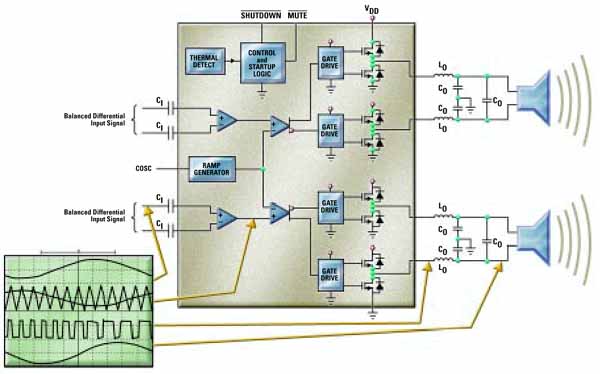
Class-D amplifiers process analog signals using pulse-width modulation (PWM) techniques, the key behind Class-D amplifiers’ increased efficiency. The PWM signals are applied to power DMOS H-bridges providing high output current capability. High-frequency square waves of constant amplitude, but varying width, are output from the IC. These pulses of
varying widths contain the audio information. The output signal must be low-pass filtered to isolate the audio information
from the high-frequency signal. Proper filtering assures the quality of the sound produced by the system. The block diagram illustrates this process.
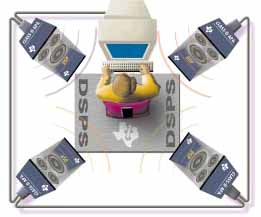
Because of their compact size, low heat dissipation and power consumption, future generations of Class-D APAs will play an important role in digital sound systems. A typical application uses a personal computer (PC) as the center-piece of a home entertainment system. Class-D APAs are critical to the development of digital speakers capable of Dolby® Digital or Dolby
Surround® playback.
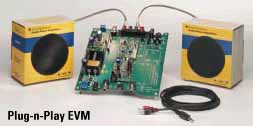
To help designers implement Class-D audio power amplifiers, TI has developed an evaluation module (SLOP223) fully compatible with its APA Plug-n-Play Platform, the only one of its kind in the industry. Also available is the Audio Power
Analysis Program. The software tool helps designers make quick and accurate calculations on power requirements and thermal data using real.wav files.
To help maximize sound quality, a comprehensive application note on low-pass filtering will be available later in the
fourth quarter of 1998. Full documentation for the TPA005D02 EVM includes a user’s guide with reference designs and schematics. Gerber files are available on request.
|
|
The TPA005D02 delivers a full 2-W RMS to each speaker with a 5-W peak capability to reduce clipping and keep THD+N
below 0.5 percent across the entire audible frequency band.
|
|

Vol 29 November, 1998
| 


 Inside:
 Showcase (Volume 29) is available in HTML and PDF format. - 330KB