Inside:
 Showcase (Volume 29) is available in HTML and PDF format. - 330KB Showcase (Volume 29) is available in HTML and PDF format. - 330KB
|
USB maximizes Windows® 98 performanceProduct features
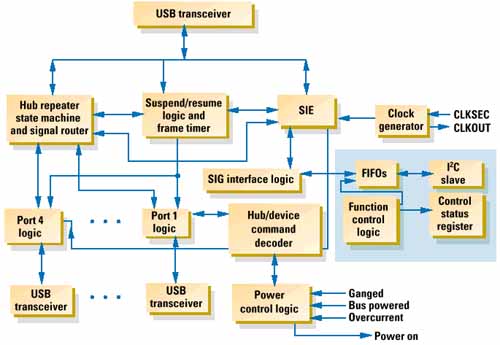
With USB support built in to Windows(r) 98, users can now connect joysticks, video-conferencing cameras, scanners and other types of peripheral hardware to their PCs, without rebooting. It is also possible to connect more than one monitor to the same system for dual display desktops. Or, USB can be used to pull digital audio signals directly from the Internet, CDs, or DVD and convert them to analog sound in the speaker, rather than through an add-in sound card. This diminishes potential noise pollution from the PC and greatly enhances sound quality. Designed to provide the interface between these new USB maximizes Windows 98 performance USB peripherals and the host PC is the TUSB2140B, a compound 4-port, standard-compliant USB hub that also adds an embedded function. The embedded function is USB display class compatible, and includes a control endpoint and interrupt endpoint to support USB data transfers. The ’2140B will also be available in a 44-pin PGT (LQFP) package in January 1999. The associated FIFOs and control registers for these endpoints are fully integrated within the device. In addition, an Inter IC (I2C) 2-wire serial interface is provided for a local microcontroller to access the FIFOs and control registers. It also contains state machine functionality to respond to USB requests providing both quick response time and minimize software overhead in the attached microcontroller. USB compatible transceivers are provided for all upstream and downstream ports. All external downstream ports support both full and low-speed connection by automatically setting the slew rate according to the speed of the device attached to the port. To reduce power consumption, the ’2140B supports ganged mode as well as per port mode for power switching and overcurrent conditions, as well as a self-powered and bus-powered mode.
Vol 29 November, 1998 |
|