Programmable synchronous buck
regulator controllers
Product features
- ±1-percent reference over full operating temperature range
- Synchronous Rectifier Driver > 90 percent efficiency
- 30-V rated floating high-side driver
- Programmable output voltage range of 1.3 V to 3.5 V
- User Adjustable Hysteretic Controller
- Droop compensation
- Adjustable overcurrent protection
- Characterized for operation from 0° C to 125° C
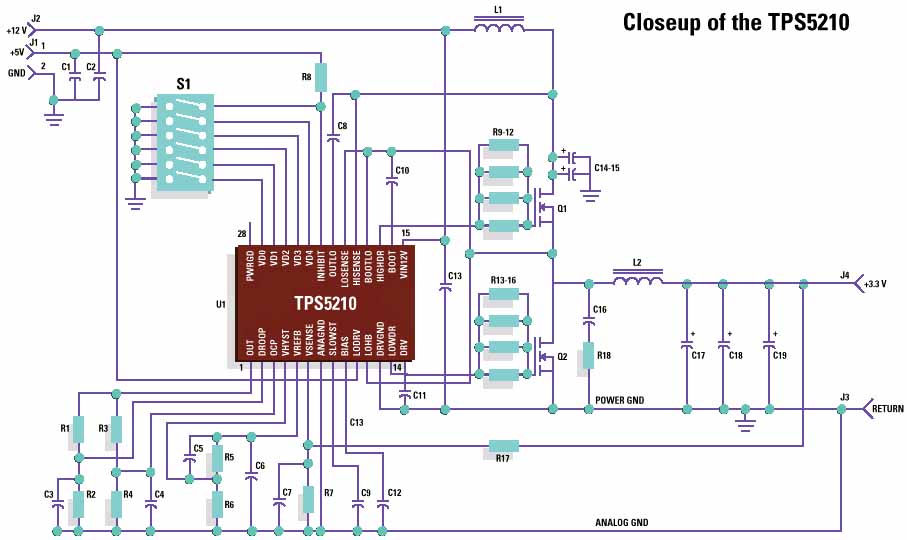
Closeup of the TPS5210
The TPS5210 is a fast and efficient Programmable-Synchronous Buck Regulator Controller. This device can be used for accurately controlling the powering of high performance microprocessors used in workstations, servers and next generation desktop computers where power requirements may be 40 to 80 watts for the processor alone.
An internal 5-bit DAC and ±1-percent reference are used to program the output voltage between 1.3 to 3.5 V in 50-mV
increments. The TPS5210 employs a hysteretic controller with droop compensation that tightly regulates the output voltage, and dramatically reduces the overshoot and undershoot caused by load transients. With its wide loop bandwidth, the hysteretic controller provides a load transient response that is only limited by the propagation delay and the output LC filter. The propagation delay from the hysteretic converter to the output drivers is only 250-nsec maximum. The output drivers employ overcurrent shutdown and crossover protection eliminating the possibility of destructive faults in the output FETs.
|
An internal 5-bit DAC and ±1-percent reference are used to program the output voltage between 1.3 to 3.5 V in 50-mV
increments.
|
A soft-start current source, proportional to the reference voltage, eliminates variations in the soft-start timing when
programmed changes are made to the output voltage. Internal circuitry monitors the output voltage to generate a Power Good signal and for overvoltage protection. The Power Good pin is pulled low when the programmed output voltage falls below 93 percent; and the output drivers are disabled when the output exceeds 15 percent of the programmed value. Inhibit and undervotage lockout are provided to assure that the 12-V supply voltage and the system supply voltage (5 V or 3.3 V) are
within their operating limits before the controller starts. The output driver circuits include 2-A drivers with an internal 8-V gate-drive voltage regulator.
The TPS5210 is available in both a 28-pin SOIC and 28-pin PowerPad package.

Vol 29 November, 1998
| 


 Inside:
 Showcase (Volume 29) is available in HTML and PDF format. - 330KB