|
Wireless Terms Digital Signal Processors Paging and Messaging Base Stations OEM requirements 'C6x Performance Handsets Digital Baseband ABB RF Power Management |
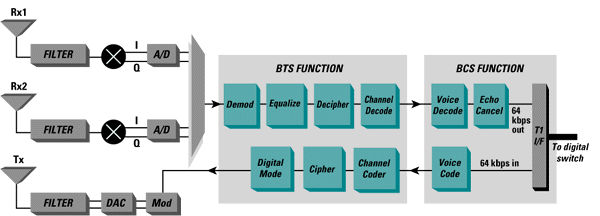
Base station OEM requirementsTI is a key provider of the products, systems expertise and technology that helps wireless OEMs meet diverse market requirements.In order to reduce the size of base stations while increasing the number of channels handled and services offered, original equipment manufacturers (OEMs) face exacting design requirements. As the world's leading supplier of DSPs and DSP Solutions, TI's a key provider of products, systems expertise and technology that helps OEMs of wireless equipment meet these requirements. Figure 2 shows the importance of DSPs in wireless base stations.
An overriding OEM concern is keeping system costs low, since the highly competitive wireless market requires continual reduction in per-channel costs. TI's IC design and manufacture is the key to rapid cost reduction, along with high performance, low power requirements, and the integration of key functions that simplify system design and help OEMs get their products to market faster. Equivalent in importance to cost is high system performance, which helps OEMs add more channels to their systems with fewer chips. Higher performance also enables advanced voice-coding algorithms that can open bandwidth for more channels, or be used to increase voice quality through filtering, echo cancellation and other advanced functions. Signal encryption, which ensures greater privacy for users and greater billing security for service providers, also demands high system performance. TI's TMS320C6x and TMS320C54x generations of DSPs are optimized to provide the performance required for specific wireless applications. In addition, TI product roadmaps assure OEMs that the IC products they are using will continue to increase in performance, so that future system generations can continue to evolve. Another requirement of base station OEMs that must be met is the on-chip integration of large amounts of memory. Base stations require substantial blocks of RAM in order to handle rapid changes of data as callers enter and depart cell areas. Other requirements include low IC power consumption to reduce the need for cooling fans and space and to minimize the need for backup power. OEMs also need ICs with multiple advanced peripherals, like enhanced buffered serial ports, to help designers handle multiple channels per DSP. Support for multiple DSPs in the same system requires the processors to share memory, buses and peripherals for minimal board space and cost. On-chip multiprocessing support appears in the form of host port interfaces that allow the DSPs to communicate with each other without additional glue logic. TI has directed its hardware development efforts at providing solutions, such as TMS320C6x and TMS320C54x DSPs, that address these and similar requirements. In addition, TI's strong software development tools help OEMs achieve fast time-to-market with their new products, as well as ease of update for existing products in order to change or add standard-compliant software. With good software support, OEMs find it easier to modify existing designs in order to enter new markets. The key to a wireless futureAs an essential element of wireless communications, base stations must meet the demands of consumers for greater capacity, better voice quality, and more advanced features such as faster data communications -- all at a lower cost. At the same time, base stations are evolving from enormous macrostations with vast transmitting power to minute, special-purpose picostations with smaller transmitting power but higher processing loads. TI's new TMS320C6x generation of DSPs is designed to help OEMs provide base station products that can meet the evolving needs of the wireless marketplace. Just as earlier generations of TI DSPs have served to increase the performance and decrease the cost of wireless telephones, 'C6x DSPs will be a key enabler of wireless base stations into the next century.
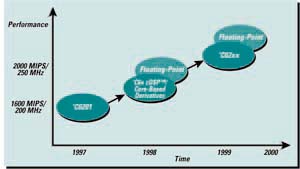
TMS320C6x product roadmap |