


 'C67x Generation: First 1-GFLOPS Floating-Point DSP 'C67x Generation: First 1-GFLOPS Floating-Point DSP Now at $995, new TMS320C62x EVM saves designer development time EDN names TMS320C6000 "Innovation of the Year" Application Report: Performance analysis of line-echo-cancellation implementation using TMS320C6201 'C54x DSPs accelerate convergence of voice and data 'C54x reference design helps pack more density into your system 'C/LC206 DSPs hit power, price point for embedded apps White Mountain offers 'C24x DSK for motor-control applications Brushless motors thrive on DSP performance Motor-control application notes online Download new DSP application notes from the web DSP Hotline Online provides quick access to design queries AC '97 codec provides high-quality PC audio Italian team wins TI DSP Solutions Challenge U/Mass Dartmouth sponsors DSP workshops TI sponsors online ICSPAT technical conference on DSP Solutions |
'C54x DSPs accelerate convergence of voice and data
The ’C549 and ’C5410 are progressive evolutions of the same core code-compatible architecture. Each device has greater integration of on-chip memory, with 32K and 64K words of on-chip RAM, respectively. The roadmap for this generation has plans for DSPs with even more on-chip RAM. In addition, new peripherals have been added to the ’C5410 that further enhance the chip’s sustained performance and productivity.
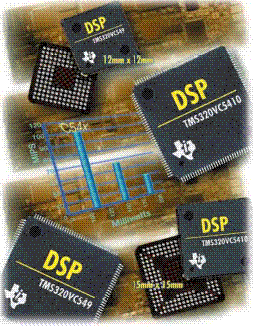
Uncommon strengthsLike the ’C549, the new device combines several uncommon strengths that differentiate them in the industry. No DSP on the market today can match the ’C549 and ’C5410 in terms of integration, low power consumption, small packaging, and performance— the combination of which is becoming increasingly vital for communications applications. The architecture and instruction set of the ’C54x generation enable extremely small code size for DSP functions, allowing these DSPs to take maximum advantage of their on-chip RAM. Having up to 64K words of available on-chip SRAM enhances performance and reduces overall system cost. Both DSPs feature the lowest power dissipation of any DSP on the market today. At 100 MIPS, these devices dissipate only 0.45 mA/MIPS. With a core supply voltage of 2.5 V, the power dissipation is less than 115 mW using on-chip resources. These DSPs will be available in two package options: the TQFP and the ultra-small microStar BGA. No one in the industry can pack this much performance and this much memory—operating on such little power—into these ultra-small packages.
Added peripheralsThe ’C5410 features two new peripherals: the Multi-Channel Buffered Serial Port (McBSP) and the DMA controller. The McBSP enables full-duplex, bi-directional communication and direct interface to T1/E1 frames or H.100 telephony standards. It supports multi-channel transmit-and-receive up to 128 channels and data sizes from 8 bits to 32 bits. The six-channel DMA controller adds flexibility and enhanced performance. The peripherals operate independently of the CPU, maximizing the efficiency of the device.
ApplicationsThe ’C549/’C5410 devices are well suited to wireless and wireline communications, including computer telephony voice-processing equipment, voice-over internet protocol (VOiP) gateways, digital and small office/home office (SOHO) PBX systems, and wireless local loop, LAN and digital PBX systems. In addition, these DSPs are being used in space-constrained applications, like digital radios and portable information appliances, which require DSP performance at low power.
AvailabilitySamples of the ’C549 are available now with production quantities scheduled for 3Q98. Samples of the ’C5410 are planned for October 1998 and production quantities are scheduled to be available in 2Q99. Pricing for production quantities of 10,000 is expected to be US $25.00 for the 100-MIPS ’C549 in 3Q98, and US $29.85 for the 100-MIPS ’C5410 in 2Q99. The ’C549 and ’C5410 are available in TQFP (thin quad flat pack) and microStar BGA packages.
Introduction to the |
 TI’s recently-disclosed