


 'C67x Generation: First 1-GFLOPS Floating-Point DSP Now at $995, new TMS320C62x EVM saves designer development time EDN names TMS320C6000 "Innovation of the Year" Application Report: Performance analysis of line-echo-cancellation implemention using TMS320C6201 'C54x DSPs accelerate convergence of voice and data 'C54x reference design helps pack more density into your system 'C/LC206 DSPs hit power, price point for embedded apps White Mountian offers 'C24x DSK for motor-control applications Brushless motors thrive on DSP performance Motor-control application notes online Download new DSP application notes from the web DSP Hotline Online provides quick access to design queries AC '97 codec provides high-quality PC audio Italian team wins TI DSP Solutions Challenge U/Mass Dartmouth sponsors DSP workshops TI sponsors online ICSPAT technical conference on DSP Solutions |
'C54x reference design helps pack more density into your systemLooking to power up your development cycle?TI’s engineers have recently created a dual-board reference design that capitalizes on the increased density of the micro-Star BGA™ package. The prototype integrates a wide range of TI parts into a 200-MIPS multipurpose board geared to general telecommunication, networking, and telephony applications. Interested designers and developers can down-load full schematics and a manual outlining the reference design. The board is not available for resale. The reference design centers around two 100-MIPS ’C549 DSPs in the 144-ball microStar BGA package. The space-saving microStar package measures 12 x 12 x 1.4 mm, thereby reducing board space over similar pin-count Thin Quad Flat Packs (TQFP). Utilizing laser-drilled, blind-and-buried vias to route connections down through the board, rather than out from the chips as in TQFP, the designers were able to provide increased density in a compact area, without a comparable rise in board cost. For example, use of the 144-ball microStar BGA instead of a 144-pin, 20 mm x 20 mm TQFP reduces board space by approximately 75 percent, but only increases board cost by 10 to 15 percent. Each ’C549 DSP utilizes a dual power supply to increase performance and lower power dissipation. The reference platform uses TI power-supply management devices to handle the separate I/O and core power supplies. For designers who prefer TI’s TQFP, the reference board also includes a layout for the 176-pin TQFP option of the recently-disclosed ’C5410 DSP. This added feature enables the same development environment to be utilized for either the ’C549 or ’C5410 DSPs. TI’s ’C54x dual-board reference design provides a mechanism for developers to understand the specifics of designing with the ’C549 microStar BGA before committing resources to creating dedicated hardware using these devices. The proto-type design will allow developers to gain insight into what they should and should not do in the manufacturing process.
|
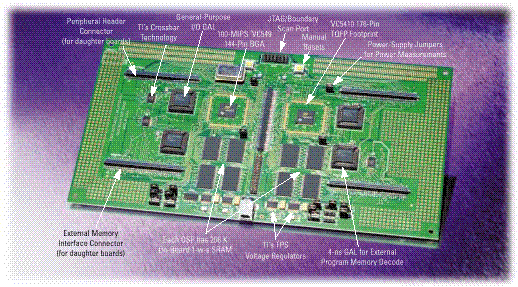 TI's C54x reference board design incorporates several TI parts, reflecting a complete DSP Solution. |
