


 In This Issue
Networking
DSP Solutions
Mixed Signal
App Report
Reader Survey
News Briefs |
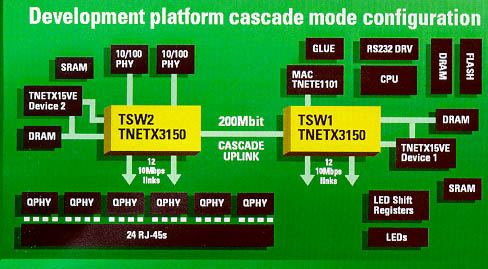 To increase port density, two TNETX3150 devices can be used in cascade mode. In this mode, there are some special considerations that must be addressed before implementing the Spanning Tree Algorithm.
Implementing the Spanning Tree Algorithm Using TNETX15VE and TNETX3150The Spanning Tree Algorithm is an intelligent algorithm that is used to eliminate packet looping in Local Area Networks (LAN). This document provides a detailed discussion of the Spanning Tree Algorithm. Topics include Configuration Bridge Protocol Data Unit (CBPDU) messages, requirements, operation, and port states, VLAN-Engine Address-Lookup Device (TNETX15VE) and ThunderSWITCH (TNETX3150) configuration. The Spanning Tree Algorithm (IEEE 802.1D) is a program that resides in all managed network switches. It was developed by the IEEE standards body as a solution to packet looping. It configures the LAN by transmitting and evaluating the contents of Bridge Protocol Data Units (BPDU). Initially, all switches broadcast BPDUs out all ports. The receiving switches then update the BPDUs and broadcast them. This process continues until all switches contain the same network configuration. The algorithm then assigns port functions and states to eliminate packet looping. In a switch without the Spanning Tree Algorithm, the forwarding and learning process assumes the topology of the LAN is a tree, or there is only one path between any two nodes separated by a switch. When a switch receives a broadcast packet, it will automatically broadcast the packet to all its ports, except the port it received it on. In turn, the next receiving switch will forward the packet to all its ports, except the port it received the packet on. The packet may eventually be forwarded to the originating LAN segment. The switches will continue to forward the packet, thus creating an infinite loop. Packet looping continues until there is a break in the loop, such as a turned off switch. If loops exist (multiple paths), then packets may be duplicated or travel through the LAN endlessly. With potentially hundreds of nodes on a segment, packet looping will cause a network crash.
The complete application report is available at:
|
