In This Issue
Networking
DSP Solutions
Mixed Signal
App Report
Reader Survey
News Briefs |
New PHYs offer Ethernet options
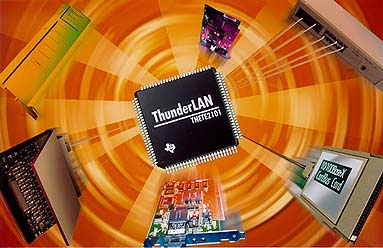
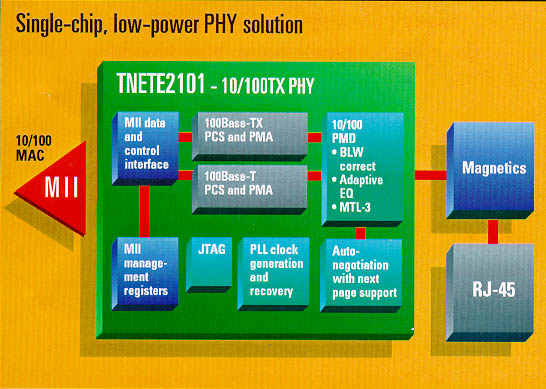
Three new 3.3-V PHYs in TI's ThunderSWITCH™ family of networking products provide designers with multi-port, multi-speed options that can save board space, component counts and time-to-market. A fourth 3.3-V device implements the industry's first standards-based gigabit Ethernet transceiver using mainstream silicon processes. Ethernet equipments such as network interface cards (NICs), PC motherboards, bridges, repeaters, 10/100 hubs, routers and LAN switches can benefit from the new ThunderSWITCH devices. Two of the new PHYs are designed specifically to simplify the migration from Ethernet to Fast Ethernet with a low power, single-chip device. The single-chip TNETE2101 10/100PHY offers industry-standard connectivity for both Ethernet and Fast Ethernet; and the TNETE2104 Quad 10/100 PHY, still in development, provides four independent 10/100 PHYs in a single package.
With reduced power consumption, the PHYs release power for use in other product functions, such as supporting more user ports or a larger switching fabric. The TNETE2101 reduces power consumption by 300 percent over popular two-chip solutions, while the TNETE2104 will use only one-sixth the power of current devices. The savings in power consumption allows OEMs to increase port density, reduce the costs of associated power supplies and cooling fans, and deliver products in smaller form factors such as CardBUS. Additional features of both devices include a phase-locked loop (PLL) that provides a single clock for both 10- and 100-Mbps operation, a single RJ-45 connector supporting both transmission speeds, and auto-negotiation to sense both port speed and half- or full-duplex operation and adjust the communications speed accordingly.
Greater 10Base density Another product in development, TI's TNETE2008 Octal Sync PHY provides eight 10Base-T full-duplex PHYs in a single chip. The TNETE2008 provides double the capacity, a smaller footprint, and lower power consumption than current PHY devices, enabling developers to produce switches with a lower cost per port in less time. The TNETE2008 synchronizes its multiple network channels, reducing the number of clocks from eight to one. The single clock eliminates the need for extensive clock synchronization within the switch, helping lower costs in the switch chip. Gigabit Ethernet transceiver Also in development is the TNETE2201 1.25-Gbps Ethernet transceiver, which operates at 10 times the speed of today's 100-Mbps Fast Ethernet technologies. The device supports the Category 5 wiring used in desktop connections, helping speed up the availability of gigabit Ethernet to the end user. TNETE2201 features include compliance with the ANSI X3T11 Fibre Channel standard, as well as the functional and timing requirements of the proposed 802.3z specification for a 10-bit interface. Data serialization and deserialization tasks that are required for gigabit Ethernet are also incorporated. "Although standards for gigabit Ethernet are not expected to be finalized until 1998, the ThunderSWITCH 1.25 Gbps transceiver enables networking vendors to begin designing their products now," said Robert Pace, enterprise marketing manager at TI. Pricing and availability Planned production schedules for the new ThunderSWITCH interfaces are shown in the accompanying table. The TNETE2101 will be available at U.S. $14 per unit in quantities of 10,000. ThunderSWITCH is a trademark of Texas Instruments Incorporated.
New ThunderSWITCH interfaces
| ||||||||||||||||||||||||||||||||||||||
 Designers of Ethernet and high-speed Ethernet equipment now have a larger range of choices among advanced physical layer interfaces (PHYs), thanks to new product developments from Texas Instruments.