



In This Issue
Wireless
Mixed-Signal and Analog
|
PCM codec-filter combo supports four channels on a single chip
The device, designated the TCM38C17 QCombo™, complements TI's existing advanced DSP-interface codec solutions in the central office switching and modem product areas. It incorporates the industry's leading idle-channel noise performance resulting from sigma-delta analog-to-digital (A/D) and digital-to-analog (D/A) signal conversion, a unique feature among today's non-programmable combos. The QCombo's architecture is expected to be reused in many future advanced codec designs from TI. The TCM38C17 QCombo brings lower cost, extremely low noise and low power consumption to a wide variety of applications that connect analog voiceband signals to digital communications systems. Among these applications are line cards for subscriber access equipment in central offices and remote sites, private branch exchanges (PBX), digital telephone answering devices (DTADs) and other voiceband communications systems, especially those based on digital signal processors (DSPs). The 'C17 QCombo integrates the functionality of four of TI's TCM29C13 combos on a single device, lowering chip counts and saving costs for original equipment manufacturers (OEMs). The device provides increased voice and data line card capacity over the existing voiceband telecommunications infrastructure. This increased line card channel capacity is key for future voice and data transmission protocols over twisted pair systems such as digital subscriber line (DSL). The 'C17 QCombo typically displays transmit-channel idle channel noise of 10dBrnCO/-80dBmOp or better. Interchannel crosstalk, a potential concern for a multichannel codec, is typically less than -100dB. The QCombo gives designers the flexibility to use a single-ended or differential receiver output, allowing maximum voltage swings of 8Vpp. This eliminates the need for external amplification and allows direct connection to a transformer. The device requires only a single-rail +5-V power supply, contributing to low power consumption and eliminating the need for the second power supply required by first-generation combos. A differential output drives a transformer load directly and provides an extremely wide signal swing from a single-rail codec. The 'C17 QCombo's compliance with ITU (formerly CCITT) telephony specifications assures virtually universal interoperability in line cards and other equipment with functions performed by the device. Pin-selectable u-Law or A-Law companding supports digital communications applications worldwide. The 'C17 QCombo is now available from TI and its authorized distributors.
Suggested resale pricing in U.S. dollars in 1K quantity. QCombo is a trademark of Texas Instruments. |
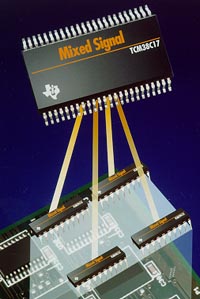 TI's latest mixed-signal technological innovation is a highly integrated pulse-code-modulated (PCM) codec-filter combo that supports four channels on a single chip.