



In This Issue
Wireless
Mixed-Signal and Analog
|
The next generationThe TI and Java connection will help build unlimited possibilities for future wireless systemsWithin the next few years, wireless communications will improve dramatically. That's a given, considering the ever-changing nature of technology. But just how dramatic will these advances be?
These and countless other uses will be available to wireless subscribers because of the flexibility of software platforms like Java™, a programming language developed by Sun Microsystems Inc. Java is based on a computer language similar to C, but with special features ideal for distributing program intelligence throughout a network. It enables the downloading of software and service to mobile handsets and opens up new opportunities for supplying data and multimedia services along with voice. As a Java licensee, Texas Instruments is working to design Java into its Digital Signal Processing Solutions (DSPS) for wireless systems, helping to bring about new kinds of communication for the wireless industry. New software paradigm Java has introduced a new software paradigm to computing. Systems no longer have to contain all of the software they use. Instead, they can receive code through the network. Using Java, mobile systems such as wireless handsets can increase in functionality but remain "thin." That is, they will not need disk drives or large amounts of firmware in order to execute numerous programs. Thin handsets can also be updated through the network -- an important advantage in the highly competitive wireless industry. Providing the capability to manage a system's software repertoire by reprogramming on the fly is only one of the advantages Java brings to wireless instruments. In addition, Java is one way service providers can make full use of the power of digital communications for bringing greater functionality and user appeal to wireless applications. Some of the applications that Java will make more readily available include voice mail, access to the Internet or enterprise data bases, global positioning, traffic assistance and many other forms of voice and data communications that can be activated by either keypad inputs or speech recognition. Real-time multimedia applications such as videoconferencing are also possible in succeeding generations of equipment. Java's advantages While these applications could be implemented as proprietary, custom developments, they would carry a high price tag and would be unlikely to be interoperable among hardware platforms. The standard platform definition that Java provides is key to the widespread development and deployment of mobile applications by third-party software vendors. The availability of third-party software will, in turn, simplify implementation for service providers and stimulate the market for new services and the use of wireless airtime among users. Java has already demonstrated many advantages for the Internet and other wired networks, but its real impact is only beginning to be felt. As Java migrates to embedded, often mobile systems, it will enable them to perform many functions that they could not perform previously. Overall network intelligence will grow rapidly, and individual networked devices will learn how to behave in diverse roles. A world of opportunity As the latest addition to TI's software platform, Java will make it possible for OEMs, service providers and third parties to develop new applications that add even greater value to systems for end users. TI's Java strategy extends beyond licensing. TI participates actively in industry standardization activities that affect wireless telephony, including a committee working to define a Java speech API. As service providers look into the future of their industry, they perceive the need for faster, more cost-effective ways of responding to changes in standards and customer demand. The Java environment offers an ideal tool for keeping systems in the wireless network up to date. At the same time, it opens a world of opportunity for adding interactive data and multimedia applications to voice, giving service providers the means to create new services that will stimulate demand for their businesses. TI is supporting Java in its DSP solutions for digital wireless systems. In the near future, wireless OEMs using TI solutions will be able to create products that can be upgraded in the field. The same products will give service providers the means to enhance their offerings with new applications, which in turn will offer end users new capabilities for remote communications. The incorporation of Java into the TI wireless platform is one of the ways TI is bringing the revolution in network intelligence to the wireless world.
How network services will use JavaJava lends itself to two different kinds of applications, plus a third approach that is a hybrid of the others. First, it will serve as a software library manager that upgrades or adds to the existing functionality of a cellular or PCS instrument through downloads of compiled code. Examples include voice encoding and compression algorithms, digital noise filters, transmission protocols, speech recognition for voice dialing and many other types of programs that run in real time. These kinds of programs will satisfy the need of service providers to upgrade units efficiently in the field. Second, Java opens up possibilities for service offerings that don't need real-time response. These services may be based on programs that operate entirely as self-contained Java applets. Accesses to voice mail, e-mail, directory service, data bases and the Internet suggest themselves as candidates for this kind of program, as do location services that help users determine travel routes or find addresses. Finally, some services will use a hybrid approach, in which a compiled program is downloaded, then activated by a Java applet. Multimedia programs, for example, will almost certainly benefit if some of the program is resident on the local system and running in real time. Java is a trademark of Sun Microsystems Inc.
|
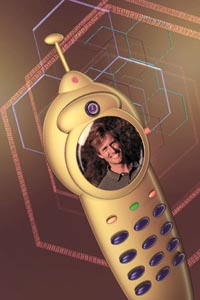 Wireless phones, for example, will be elevated to a much higher level. With larger displays and more graphic capabilities -- changes that have already begun -- they will be able to display Internet pages or images from remote cameras. Using these new systems, salespeople on the go will be able to meet their clients face-to-face via videoconferences, even when they are miles from the office. Anxious parents out for the evening will be able to see their baby sleeping. Motorists lost in a strange city will be able to consult a map -- and not the paper version -- for directions.