



Inside
|
400 DPI linear image sensor with electronic shutter capabilityProduct Features
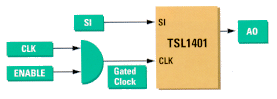
The TSL1401 is the newest member of the linear sensor array family offered by TI. This CMOS device has a pixel pitch of 400 dots per inch, maximum clock speed of 2 MHz and linearity and uniformity specs making it ideal for applications such as contact image scanning, rotary and linear encoding, edge detection and level sensing. The TSL1401 also incorporates a new hold function which provides added control over pixel integration. The hold function causes all pixels to start and stop integration at the same time, rather than sequentially as each pixel is clocked out. This helps eliminate image skewing which can be a problem with conventional linear arrays. Additionally, the clock can be gated to provide an electronic shutter function, further increasing the flexibility of the device.
In many applications, particularly when the target is moving at a high speed, it is necessary to have fine control over the exposure period. In some cases this can be accomplished by strobing the light source, but becomes very difficult when using incandescent or fluorescent bulbs. This control can be accomplished through the electronic shutter feature on the TSL1401. The shutter feature can be activated by clocking in the SI pulse and then stopping or gating the clock. Integration is then stopped, and the pixels can be clocked out at a later time. Integration begins again after the 18th clock pulse.
Vol 19, October, 1996 |
