



Inside
|
Optocoupler with feedback for analog signalsProduct Features
 Analog signal isolation is required for many applications found
in telecommunications, industrial process control, medical instrumentation
and switch mode power supplies. The TIL300 precision linear
optocoupler provides the design engineer a cost effective alternative
to bulky isolation transformers used in these applications. It
consists of an LED that illuminates two photodiodes. The input
photodiode can be used to monitor and therefore control the light
output of the LED. This eliminates the effects of the nonlinearity
and drift characteristics of the LED. The output photodiode then
produces a current that is linearly proportional to the output
of the LED. Matching of the photodiodes and package design enable
the high linearity and stable gain characteristics of the optocoupler.
The TIL300 is very flexible and is capable of operating in many
different modes including unipolar/bipolar, AC/DC, and inverting/non-inverting.
Analog signal isolation is required for many applications found
in telecommunications, industrial process control, medical instrumentation
and switch mode power supplies. The TIL300 precision linear
optocoupler provides the design engineer a cost effective alternative
to bulky isolation transformers used in these applications. It
consists of an LED that illuminates two photodiodes. The input
photodiode can be used to monitor and therefore control the light
output of the LED. This eliminates the effects of the nonlinearity
and drift characteristics of the LED. The output photodiode then
produces a current that is linearly proportional to the output
of the LED. Matching of the photodiodes and package design enable
the high linearity and stable gain characteristics of the optocoupler.
The TIL300 is very flexible and is capable of operating in many
different modes including unipolar/bipolar, AC/DC, and inverting/non-inverting.
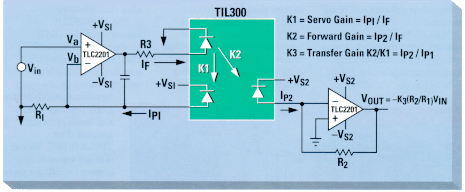
The photodiodes can be operated in the photoconductive or photovoltaic modes. In the photoconductive mode the maximum bandwidth of the device is realized at the expense of increased dark current. For applications that require the best linearity and/or the lowest dark current the photovoltaic mode should be used. The TIL300 is available in two versions, the TIL300A with transfer gain tolerance of ±10% and standard TIL300 with transfer gain tolerance of ±25%. A typical application circuit uses an operational amplifier as the input to drive the LED. The feedback photodiode sources current through R1 which is connected to the inverting input of the input opamp. The photocurrent IP1 will assume a magnitude that will satisfy the relationship IP1 = VIN / R1. The magnitude of this current is directly proportional to the LED current IF, (IP1 = VIN / R1 = K1*IF). The input opamp will supply LED current to produce sufficient photocurrent to keep the node voltage Vb equal to Va. The flux generated by the LED will also be incident on the output photodiode and generate photocurrent IP2 = K2* IF = VO/R2. This provides a input/output transfers characteristic that is independent of the LED current, giving a transfer function that is linear across the isolation barrier VO = –K3(R2/R1)VIN . This device is available in an 8-pin DIP gullwing DCS package.
Vol 19, October, 1996 |

