



Inside
|
TL16PIR552 Dual UART with IrDA and IEEE 1284Product Features
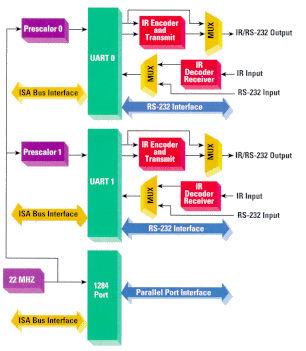 The TL16PIR552 is the first product that offers a dual Universal
Asynchronous Receiver/Transmitter (UART) with selectable Infrared
Data Association (IrDA) and RS-232 inputs and outputs, along with
a high performance IEEE 1284 parallel port.
The TL16PIR552 is the first product that offers a dual Universal
Asynchronous Receiver/Transmitter (UART) with selectable Infrared
Data Association (IrDA) and RS-232 inputs and outputs, along with
a high performance IEEE 1284 parallel port.
The dual UART performs serial-to-parallel and parallel-to-serial data conversion on data to and from a peripheral device and the CPU. It has 16-byte FIFOs which reduce CPU interrupts and auto flow control to relieve the CPU from monitoring flow status information and to increase system efficiency. Both UARTs have independent selectable RS-232 and IrDA for the inputs and outputs. This offers a high degree of flexibility in the system design. There are separate inputs for the IR and RS-232 data, and one multiplexed output that can be used for either an IrDA or RS-232 connection. The IrDA controllers have transmission data rates from 1200 bps to 115.2 Kbps; and they interface directly to an external IrDA compatible transceiver. The IR encoder and decoder work with the UART to change a serial bit stream into a stream of pulses. At the 115.2 Kbps data rate, the IrDA protocol defines a serial infrared data "word" to be surrounded by a start bit equal to 0 and a stop bit equal to 1. Individual bits are encoded or decoded the same irrespective of whether they are start, data, or stop bits. The TL16PIR552 provides the user with a 1284 host side compatible, bi-directional parallel data port. It is compatible with the standard Centronics parallel interface and supports the Extended Capability Port (ECP) and Enhanced Parallel Port (EPP) Protocols. The parallel port consists of an 8-bit host interface (including DMA support) which is connected to the fast-AT bus, a sequencer containing state machines for the three different protocols, a 16-byte FIFO data path and a parallel interface. The parallel port and two serial ports in the TL16PIR552 provide IBM™ PC/AT™ – compatible computers with a single device to serve a three port system. This device is available now in an 80-pin QFP package.
Vol 19, October, 1996 |

