



InsideShowcase (Volume 27) is available in HTML and PDF format. - 179KBPowerFLEX™, a low-cost alternative to TO-220 High performance PLL clock drivers Digital control loop for 3-phase brushless dc motor Cost-effective gigabit ethernet transceiver SN75LVDM976, industry's first discrete dual mode LVDS SCSI transceiver TRF2050, a 1.2 GHz fractional-N/integrator-N syntheszier New external memory interface provides 8 hour speech duration |
Industry’s first discrete dual-mode LVDS SCSI transceiverProduct Features
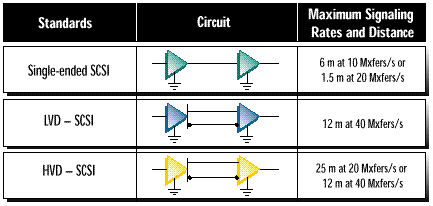
TI announces the SN75LVDM976, the industry’s first nine-channel discrete dual-mode transceiver which supports both single-ended signaling SCSI and low-voltage differential (LVD) SCSI. The dual-mode characteristic of the SN75LVDM976 allows the flexibility of implementing LVD-SCSI in prevailing products or keeping backward compatibility with single-ended devices. Each of the nine transceivers offers electrical compatibility to both the single-ended signaling of X3.3.2-SCSI-3 Parallel Interface (Fast-20) and the new low-voltage differential signaling method of X3.227-SCSI Parallel Interface-2 (SPI-2). The ‘LVDM976 achieves dual-mode by using a window comparator incorporated by the CDE0 input to detect the status of the SCSI bus DIFFSENS line. The DIFFSENS line will be below 0.5 V if using single-ended signals, between 1.9 V and 2.4 V if using LVD, and above 2.4 V if using high-voltage differential (HVD). If HVD is detected, the output will be placed in high-impedance. Otherwise, the output will assume the characteristics of single-ended or LVD-SCSI. The signal symmetry requirements of the Fast-40 SCSI bus means you can no longer obtain logical inversion of the signal by simply reversing the differential signal connections. The ‘LVDM976 includes the INV/NON pin which gives the designer the ability to invert the logic convention. This input would be low for SCSI controllers with active-high data, and high for SCSI controllers with active-low data. The SN75LVDM976 is ideal for applications such as disk drives and host adapter add-in boards which interface a computer system to a differential SCSI I/O subsystem. It is offered in a thin shrink small-outline package (TSSOP) with 20 mil terminal pitch, and is pin-compatible with the SN75976ADGG high-voltage differential transceiver. To order your free copy of the: Vol 27 May, 1998 |
|