|
Wireless Terms Digital Signal Processors Paging and Messaging Base Stations Handsets Digital Baseband Core architecture Worldwide standards ABB RF Power Management |
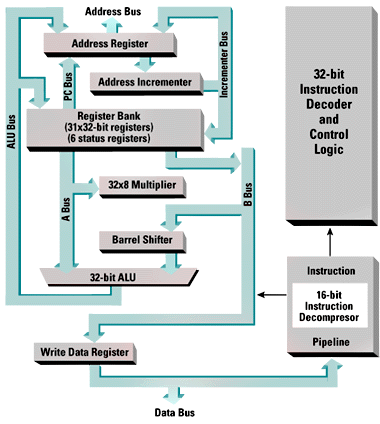
TMS320C54x DSP core architecture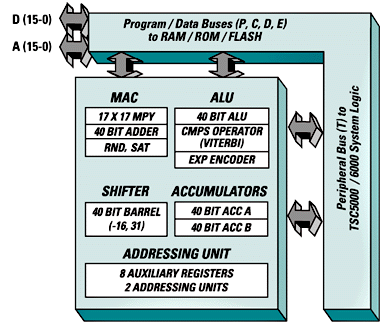 Figure 4. TI's 'C54x DSP core is optimized to meet the needs of digital wireless applications Figure 5 shows that TI's 'c470 core is well suited to the needs of low-power, high-performance embedded systems such as wireless phones. Operating at up to 75 MHz, the core features two RISC instruction sets: 32-bit instructions for execution, and 16-bit instructions for savings in memory space. The 16-bit instructions are expanded to 32 bits internally for execution. Combined with the inherent compactness of the design, this dual instruction set saves a remarkable amount of memory space and expense, as well as giving designers much-needed flexibility in code development.
TI's Digital Baseband Platform integrates all the digital components needed for digital wireless phones in a single-chip customizable DSP Solution. The MCU is also extremely compact and low in power dissipation. A 0.25-micron version, compatible with the TSC5000 ASIC library and operating at 2.5 V, is estimated at 2 square mm on the die (about one-third the size of similar MCU cores). Using TI's application-specific integrated circuit (ASIC) design methodology, system designers can integrate additional logic functions, RAM, ROM and Flash memories, and some mixed-signal functions such as phase-locked loops, analog-to-digital and digital-to-analog converters. The platform is supported by TI's 0.25-micron CMOS TSC5000 Standard Cell ASIC library. TI plans to migrate designs in 1997 to the 0.18-micron TSC6000 library, which is based on TI's 125-million-transistor TImeline™ technology. Along with ever-diminishing transistor geometries will come enhancements in mixed-signal integration, making possible future platforms that include high performance analog baseband and even RF functions on a single chip. TI software support simplifies platform development for wireless customers. DSP vocoder modules are available for various wireless transmission standards, and MCU software modules for all standards are either available or in development. TI's standard TMS320 development tools, along with the industry's leading selection of third-party tools and algorithms, support code development for the DSP core. The MCU is supported by two tool suites: one that is compatible with other TI MCU and DSP families, and another licensed from ARM. In addition, real-time operating systems for the MCU are available from leading third-party suppliers. Both cores are accessible for in-circuit emulation (ICE) through an IEEE 1149.1/JTAG test port. Special on-chip logic allows simultaneous co-emulation of both cores with a single set of emulation hardware. This unique, proprietary co-emulation capability from TI can save designers months of development time, speeding time-to-market. A single-chip digital baseband platformWith its high level of system integration, TI's Digital Baseband Platform offers a single-chip DSP Solution that saves board space, lowers component counts and reduces cost. With its support for any wireless digital standard, the digital baseband platform is designed for flexibility, allowing OEMs to differentiate their products and stay ahead in the market. Figure 6 shows a typical implementation of the platform. Digital Baseband Platform implementation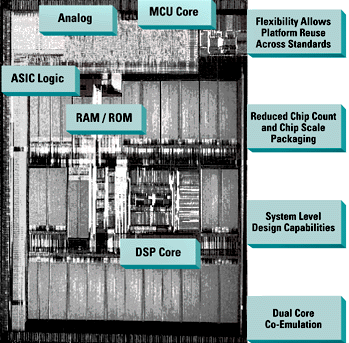 Figure 6. TI's Digital Baseband Platform combines all the digital baseband functions of a wireless digital telephone on a single customizable chip The platform's low power dissipation helps prolong battery life and allows systems to run on smaller, lighter-weight batteries. Power savings in the future promise to be even greater: TI estimates that digital baseband power requirements with 0.18-micron CMOS technology will be reduced more than 90 percent from today's technology. The 'C54x DSP will also continue to improve in performance. TI has demonstrated 3-volt 'C54x DSPs operating at 100 MIPS, and it plans to offer these in production quantities during 1997. Higher DSP performance will allow systems to support enhancements such as higher compression algorithms to improve capacity or vocoder algorithms that improve voice quality. Other possible system enhancements include support for more than one transmission standard, or new features such as voice dialing. TI's advanced packaging options include thin quad flatpacks (TQFPs) and small ball-grid arrays (BGAs), saving system space and cost. Industry-leading field and factory support, including tools and software modules, helps manufacturers get to market faster with improved products. Wireless communications leadershipThe digital baseband platform illustrates why TI has become a major solutions supplier for digital wireless systems. As the world's leading DSP and DSP Solutions provider, the company has a strong focus on wireless applications and is engaged with the leading wireless OEMs of both handsets and base stations.Today TI is shipping large volumes of DSPs, cDSPs and custom ASICs to wireless customers worldwide for phones, pagers and base stations. TI expects to ship approximately 22 million DSPs or cDSPs into digital wireless phones in 1996, representing more than half of the market. In addition, the company supplies RF and analog baseband components that are compatible with the digital baseband platform, and it is continually enhancing its product offerings in these areas, too. A wide array of Digital Signal Processing Solutions, advanced integration technologies and system-level expertise gained from working with industry-leading customers help TI's worldwide business structure meet the needs of its wireless customers and enable new developments in the wireless communications industry. |