|
Wireless Terms Digital Signal Processors Paging and Messaging Base Stations Handsets Digital Baseband Core architecture Worldwide standards ABB RF Power Management |
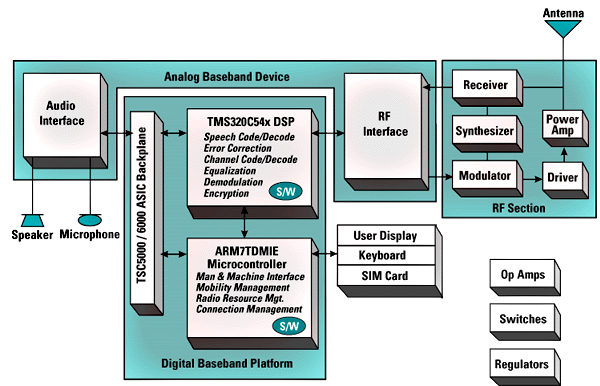
Worldwide digital wireless standards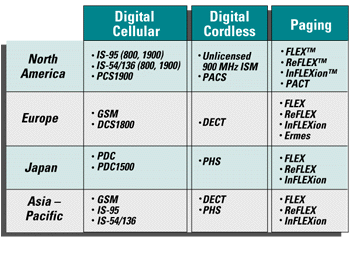 Table 1. Flexibility in baseband subsystems is important for OEMs to support the variety of digital wireless standards and applications worldwide. In order to satisfy consumers and service providers, OEMs of wireless phones and base stations must base their products on low-cost, high-performance components featuring a high level of system integration, low power consumption and advanced packaging. For wireless digital telephones, OEMs require the processing performance of advanced DSPs, combined with a flexible upgrade path for future product development and backed by DSP and microcontroller software supporting digital standards. A great challenge to OEMs is handling the variety of digital wireless standards and applications. Transmission standards, summarized in Table 1, vary widely in different regions of the world. Flexibility in baseband subsystems is critical for OEMs to support not only the variety of mature standards, but also developing standards, such as those used for the new all-digital PCS frequency band. In addition, new applications for wireless technology are appearing all the time, including two-way voice and data paging, local-area wireless phones in pedestrian areas such as shopping malls, and dual-mode phones that operate from a cordless exchange inside a plant or office building and with mobile cellular or PCS connections elsewhere for full user mobility.Ultimately, the enabling technology to satisfy all these requirements must come from an IC vendor like Texas Instruments, which has the advanced processes and products required for low operating voltages, high performance and system-level integration. TI's advanced DSP architectures provide the high-powered but efficient processing needed for wireless applications. With its system expertise, software modules and advanced packaging options, TI brings systems together with high-level solutions that enable OEMs to satisfy the needs of consumers and service providers. OEMs also rely on TI's manufacturing strength for fast time to production, a secure high-volume supply and industry-leading test and emulation capabilities. The importance of the digital baseband sectionThe heart of a digital wireless system is the digital baseband section -- important not only for its high-performance processing, but also because high levels of integration in the digital baseband section can significantly reduce system cost and power consumption.Figure 3 shows a block diagram with the three subsystems of a digital wireless telephone. The radio frequency (RF) section receives the incoming analog phone signal and converts it to a low-frequency baseband signal by stripping away the RF carrier. To transmit outgoing signals, the RF section reverses this process.
The analog baseband section converts the baseband signal it receives from the RF section into a digital signal, which it sends to the digital baseband section for further processing. After the digital signal processing is complete, the analog baseband section converts the digital signal back to analog for output to a speaker. For incoming signals from the microphone, the process is reversed. The digital baseband section performs the high-speed digital signal-processing functions of digital wireless telephony. These typically include:
In addition to DSP functions, there are other digital functions in the digital baseband section that today are more efficiently handled by a microcontroller. These functions include:
Although these functions are common to all systems using all transmission standards, they are handled differently by each. A flexible, fully integrated digital baseband solutionTI's Digital Baseband Platform integrates all the digital components needed for digital wireless phones in a single-chip customizable DSP Solution. At the heart of the platform are two complementary digital processing engines -- a TMS320C54x DSP and a 32-bit TMS470 microcontroller unit (MCU) based on the industry-standard ARM7TDMI™ (Thumb™) design licensed from Advanced RISC Machines LTD. The processor cores can be programmed to support any digital wireless protocol, so the platform can be used to design systems for use in any region of the world.As Figure 4 shows, the 'C54x DSP core is tailored to the processing needs of digital wireless phones. With an architecture optimized for wireless applications, the 'C54x core includes:
|