|
|

Related Product Information
In This Issue
DSP Solutions
New FLEX decoders support
roaming, numeric-only designs
DSP pioneers to receive first
Kilby Award
x2 is the clear 56K choice
x2: special delivery
Logic
Focus on Logic Ideas
A wealth of technical information
Memory
Flash!
Support
MCK240 tools speed DMC
development
Semiconductor Product
Information Center
App Report
TMS320C54x DSP programming
environment
News Briefs
LVDS line driver, receiver
Power interface for PC cards
300-dpi linear sensor array
A/D CCD interfaces
Low-voltage opto-isolated
feedback amps
High-speed 2-A MOSFET drivers
Trade Shows

The messaging protocol of the future: The Motorola Paging Products Group developed the FLEX messaging protocol to improve performance and reliability in message transmissions, lower power consumption in paging products and enable paging service providers to offer a new range of messaging services. FLEX has been licensed by service providers around the world and has become the de facto messaging protocol of the future.
|
|
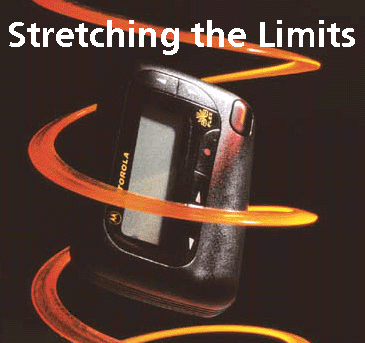
New FLEX decoders support roaming, numeric-only designs
Designers of FLEX™ paging and messaging systems now have a wider range of DSP Solutions available to them, thanks to two new decoders in TI's TMS320FLEX family of wireless messaging devices. Designated the TLV5593 Alphanumeric FLEX Decoder with Roaming and the TLV5594 Numeric FLEX Decoder, the new devices are enhancements of TI's TLV5591 Alphanumeric FLEX Decoder.
The TLV5593 adds the capability of roaming to the TLV5591 feature set. Roaming allows service providers to build multi-frequency systems that cover a wide geographic area, or that incorporate multiple frequencies in a single urban location to support very dense user populations. The world's first system with FLEX roaming, supported by the TLV5593, recently has been announced in Korea.
The TLV5594, on the other hand, focuses on the low data requirements of strictly numeric paging, enabling OEMs to reduce the cost of numeric pagers while retaining FLEX protocol benefits such as extended battery life, fast signaling speed and high reliability.
"TI's TLV559x FLEX decoders offer OEMs versatility in the paging/messaging systems they build," said Kevin Thomazios, strategic marketing manager for the TI Wireless Communications Business Unit. "TI's FLEX-based products, together with the FLEX protocol, enable paging service providers to introduce new, high-value messaging services to their customers."
Each of the TLV559x decoders is designed to function as half of a glueless chipset along with the TLV5590 analog-to-digital (A/D) converter. The chipsets interface with most popular off-the-shelf receivers and microcontrollers and are designed for ease of hardware and software upgrade, allowing OEMs to develop FLEX-compliant products quickly and easily from existing designs with minimal hardware changes. All of the decoders provide low-battery indication and real-time clock support.
Complementing the decoders is FLEX One-Way Stack, which facilitates application development by handling interchip communications and interpreting host commands for the decoder. FLEXstack modules that support the capabilities of TLV559x decoders are available on Motorola's web site at  http://www.mot.com/FLEXstack. Purchase of any of the TMS320FLEX chipsets satisfies all FLEX protocol licensing requirements for OEMs. No separate licensing agreement with Motorola is necessary. http://www.mot.com/FLEXstack. Purchase of any of the TMS320FLEX chipsets satisfies all FLEX protocol licensing requirements for OEMs. No separate licensing agreement with Motorola is necessary.
The TLV5593 and TLV5594 decoders are now available from TI. Suggested retail pricing is $8.25 for the TLV5593VF and $4.97 for the TLV5594VF, each in quantities of 100,000.
| TI's FLEX decoder family |
| |
TLV5591 |
TLV5593 |
TLV5594 |
| Functionality |
Alphanumeric |
Alphanumeric
roaming |
Numeric or
tone-only |
Programmable
address words |
16 |
16 |
4 |
Single-/any-
phase decoding |
16k, 32k, 64k |
16k, 32k, 64k |
16k, 32k |
| Package |
32-pin TQFP |
32-pin TQFP |
32-pin TQFP |
FLEX is a trademark of the Motorola Corporation. |


