APP REPORT
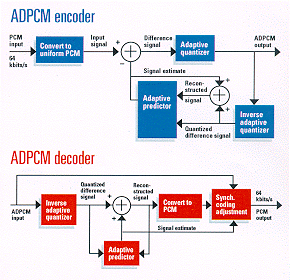
The implementation of G.726 Adaptive Differential Pulse Code Modulation (ADPCM) on TMS320C54x DSP: Adaptive Differential Pulse Code Modulation (ADPCM) is a very efficient digital coding of waveforms. In telecommunication, the main field application is speech compression because it makes it possible to reduce the bit flow while maintaining an acceptable quality. However, this technique applies for all waveforms, high-quality audio, image and modem data. That's why it's different from vocoders that use properties of the human voice in order to reconstruct a waveform that appears very similar when it reaches the human ear, even though it is quite different from the original speech signal.
ADPCM is a complete digital transcoding process. According to the CCITT standard, if the PCM input bit flow is 64 kbit/s (8 kHz sampling x 8-bit PCM word), we have to process in real-time in order to produce a 40, 32, 24 or 16 kbit/s (8 kHz * 5, 4, 3 or 2-bit ADPCM word) output flow. A fixed-point digital signal processor (DSP) has an architecture capable of doing this. In particular, the new and very efficient TMS320C54x, also called "LEAD" (for Low-power consumption Enhanced Architecture Device), enables very rapid processing.
The typical application for LEAD is for vocoders that deal with a large number of samples at the same time. Application-oriented instructions such as LMS, FIRS, SQUR, CMPS or instruction with parallel load/store do not take place naturally in the ADPCM algorithm. On the other hand, instructions such as EXP, NORM, MIN and MAX are often useful for this purpose. More generally, the ADPCM algorithms benefit from the enhanced architecture of the LEAD, which also provides advantages in general purpose applications.