



In This Issue Special Focus on Logic
DSP Solutions
Wireless
Memory
Mixed-Signal and Analog
Business News
|
Wireless
Leading the wayNew development tools and products add to TI's well-established strengthsSince the early 1990s, Texas Instruments has been building a solid business and reputation in the competitive wireless market, and the work is paying off. Among the company's recent accomplishments in this booming industry is becoming the top supplier of digital signal processors (DSPs) for digital cellular telephones worldwide -- for the second consecutive year. The recent addition of radio frequency (RF) products to its wireless lineup of DSPs, analog and mixed-signal devices, and software, adds to that strength and gives TI the advantage of providing customers all the major system blocks for portable wireless applications. 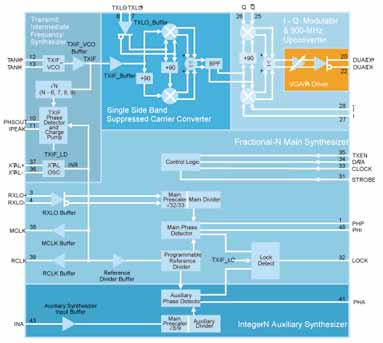 With two new DSP solutions, the TRF3040, an integrated frequency synthesizer and RF transmit modulator, and the Digital Baseband Hardware Emulation Tool, TI continues its commitment of helping designers create highly differentiated wireless equipment that lowers system power consumption, reduces component count and shortens time-to-market. Milestone in the roadmap The TRF3040 is a highly integrated RF component targeting dual-band, dual-mode applications that will allow wireless original equipment manufacturers (OEMs) to create more affordable, longer-operating mobile phones that can function seamlessly throughout the nation. Its enhanced operational characteristics provide OEMs with the design flexibility to increase system power efficiency for longer talk and standby times. They also keep overall system space, weight and cost to a minimum. "The TRF3040 modulator/synthesizer is an important milestone in our roadmap to build a leadership RF portfolio," said Gilles Delfassy, director of the worldwide TI Wireless Communications Business Unit and TI vice president. With the TRF3040, OEMs will be able to develop products that operate in both the 900-megahertz (MHz) cellular and 1.9-gigahertz (GHz) Personal Communications Systems (PCS) frequency bands used in North America. Specifically, the device supports the traditional analog AMPS transmission standard used at 900 MHz, plus the IS-136 digital standard used at both 900 MHz and 1.9 GHz. The dual-band, dual-mode features of the TRF3040 give OEMs greater flexibility to create handsets that can operate as needed in different regions of the United States and Canada. Internal system performance improvement Designed to help improve internal system performance, the TRF3040 features a high degree of variable gain amplifier (VGA) linearity, which serves to minimize spectral regrowth, the energy that spreads from a signal's carrier frequency into nearby frequencies. The TRF3040's high VGA linearity allows OEMs to use transmit power amplifiers with less performance margin (e.g. linearity), and thus less cost, yet still meet the applicable air-interface standard requirements for spectral purity. In many cases, these power amplifiers can operate on less power -- an important plus since the power amplifier is the single greatest source of power consumption, and as a result a key driver of system battery life. The TRF3040 also features a low spurious content -- the unwanted signal noise that is the byproduct of mixing frequencies -- an operation that RF systems must perform to translate baseband encoded voice and data to RF carrier frequencies compatible with today's cellular and PCS wireless systems. Low spurious content allows OEMs to meet the air-interface standard requirements through the use of lower-fidelity filter components and power amplifiers, which in many cases are less expensive and consume less power. Ease of design The device helps simplify design and reduce space and weight through a high level of integration. TI's advanced silicon BiCMOS process allows integration of a 900-MHz transmit modulator and 2.2-GHz synthesizer functions in a single chip. In addition to reducing component counts by integrating these functions, the device also eliminates the need for a separate 900-MHz up-converter. The on-chip fractional-N synthesizer allows faster frequency "lock" performance during standby-mode "wake-up" and when changing frequencies during active-mode handoffs. Typical operation at 3.75 V and 150 milliamps (mA) keep the TRF3040's power requirements low, and a sleep mode brings power-down current to less than 2 mA. The device's three-wire serial interface allows for ease of programming and enhances compatibility with a variety of baseband solutions. Simplifying development TI's Digital Baseband Hardware Emulation Tool, the first product offering in a new class of wireless tools, significantly cuts design cycles and reduces development costs for any wireless system using TI's single-chip Digital Baseband (DBB) solution. At the heart of the tool is the DBB platform, a highly integrated DSP solution that combines the high-performance, low-power processing engine of the TMS320C54x DSP core with a 16-bit/32-bit TMS470 microcontroller core based on the ARM7TDMI (Thumb™) design. The tool consists of TI's DBB device with 112K words of on-chip DSP random access memory (RAM), an application specific integrated circuit-based (ASIC) library of commonly used peripheral modules such as timers and a serial port interface. With more than 1.5 Mbytes of external RAM and 1 Mbyte of flash memory resident within the tool, customers can simulate the future internal RAM or read only memory (ROM) code for the ARM processor. This gives developers enough memory space to develop and test embedded software before actual hardware is available. In addition, there is an unoccupied socket where designers can install an ASIC or field programmable gate array (FPGA) -- via a daughter board -- for the development of end equipment-specific differentiating capabilities. The Digital Baseband Hardware Emulation Tool will be used in conjunction with TI's standard development tools for the TMS320C54x and TMS470 processor cores. These development tools include a C compiler, assembler, linker and an XDS510 hardware emulator. For real-time trace capability, the tool will also connect to a logic analyzer. 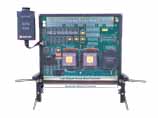 Flexible and reusable Because the DBB is a completely programmable device, the new tool can be used to develop wireless systems for any region of the world using any international transmission standard, including GSM, IS-136, IS-95 and others. The large RAM array on the tool accommodates a wide reuse of memory required for different transmission standards. TI plans to implement new versions of the Digital Baseband Hardware Emulation Tool as new DSPs, microcontroller cores or DBB platforms are introduced. Additional hardware and software development tools continually will be made available to support the custom development of complete wireless systems. Advanced software development capabilities from TI are planned to support the implementation of next-generation systems and industry-leading features such as Internet access from wireless communication systems, multimedia applications, broadband data transmission capabilities, speech recognition and others. Availability The TRF3040 is sampling now. Evaluation modules are scheduled for August, and volume production is scheduled for the 3Q98. The device is delivered in a 48-pin thin quad flatpack (TQFP) package. Planned pricing is $6.07 each in quantities of 10,000. The Digital Baseband Hardware Emulation Tool is ready for current engagements for OEMs seeking a high level of customization to their system architecture with high-volume applications based on TI's DBB solution. Suggested pricing is $6,500. Non-recurring engineering costs and pricing for a custom DBB device varies based on each customer's specific design configuration. ARM and Thumb are trademarks of Advanced RISC Machines Ltd. For complete information, order: DBB Hardware Emulation Tool Product Bulletin (SPRT153), TRF3040 Product Bulletin (SWRT010) and Wireless Brochure (SPRB115B). See Related Product Information
|